Inside Abu Simple Dome
Inside Abu Simple Dome
Carved into the sandstone cliffs of southern Egypt, near the border with Sudan, the Abu Simbel Temples are among the most awe-inspiring monuments of the ancient world. Built by Pharaoh Ramses II in the 13th century BCE, these twin temples—one dedicated to the gods Amun, Ra-Horakhty, and Ptah, and the other to his beloved queen Nefertari—are not only architectural marvels but also powerful symbols of divine kingship and imperial might. While the colossal statues on the façade are world-famous, stepping inside the Great Temple reveals a hidden world of grandeur, spirituality, and celestial alignment.
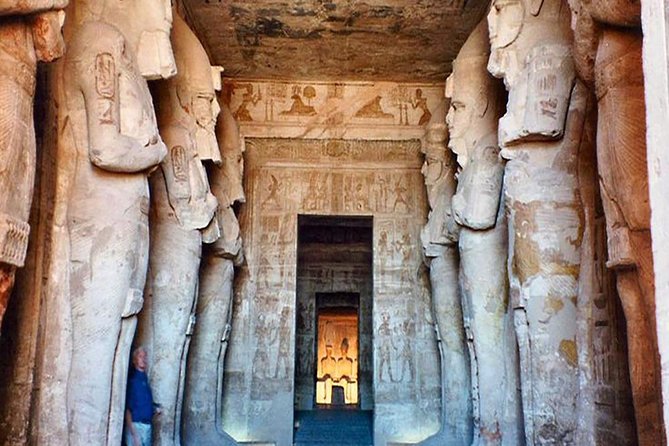
The so-called “dome” of Abu Simbel refers not to a literal dome, but to the arched ceilings and vaulted chambers within the temple’s interior, which create a sense of sacred enclosure. Upon entering the Great Temple, visitors are greeted by a hypostyle hall lined with eight massive Osirid statues of Ramses II, each standing over 10 meters tall. These figures, carved directly from the rock, depict the pharaoh as the god Osiris, symbolizing his eternal life and divine authority.
The ceiling of this hall is gently curved, painted with flying vultures—symbols of protection and royal power. The walls are covered in intricate reliefs depicting Ramses’ military victories, including the famous Battle of Kadesh, as well as scenes of ritual offerings to the gods. The artistry is both narrative and symbolic, designed to reinforce the pharaoh’s role as both warrior and priest.
Deeper inside, the temple narrows into smaller chambers, culminating in the sanctuary, the holiest part of the temple. Here, four seated statues—of Ra-Horakhty, Ramses II, Amun, and Ptah—sit in solemn silence. This chamber is the heart of Abu Simbel’s celestial mystery: twice a year, on or around February 22 and October 22, the rising sun penetrates the temple’s axis and illuminates the statues, except for Ptah, the god of the underworld, who remains in shadow. This solar alignment is a stunning example of ancient Egyptian astronomical precision and religious symbolism.
The interior of the smaller temple, dedicated to Queen Nefertari and the goddess Hathor, is equally captivating. Its walls celebrate the queen’s divine status and her close relationship with Hathor, the goddess of love and music. The ceilings here are adorned with stars, and the columns are crowned with Hathor-headed capitals, creating a more intimate, feminine atmosphere.
What makes the experience inside Abu Simbel even more remarkable is the knowledge that the entire complex was relocated in the 1960s to save it from the rising waters of Lake Nasser, caused by the construction of the Aswan High Dam. In a feat of modern engineering, the temples were cut into massive blocks and reassembled 65 meters higher and 200 meters back from their original location. The interior chambers, including the sanctuary and its solar alignment, were meticulously reconstructed to preserve their original orientation and magic.
Walking through the inner sanctums of Abu Simbel is like entering a sacred time capsule. The silence, the scale, the interplay of light and shadow—all combine to create a deeply spiritual experience. It’s not just a monument to a king, but a cosmic temple where architecture, astronomy, and theology converge.
For those who venture inside, the Abu Simbel “dome” is more than stone and sculpture—it’s a celestial chamber where the sun still honors a pharaoh, and the gods still dwell in shadow and light.






.jpg)